
Friday, August 1, 2014
Sound Spectrum of a Pop Toob

Wednesday, July 23, 2014
Infrared Image of Warm-Blooded and Cold-Blooded Animals
This FLIR image was taken of warm-blooded people and a pygmy African hedgehog, as well as a cold-blooded corn snake.

Tuesday, July 15, 2014
Vernier Oxygen and Carbon Dioxide Sensors Around a Campfire
I slowly walked around the glowing coals of a campfire tonight while holding Vernier oxygen and carbon dioxide sensors at about hip level. The highs in the carbon dioxide readings correspond to lows in the oxygen readings, and these highs and lows correspond to when I was roughly east of the fire. Though the wind was almost calm, it appears to me that the "smoke" from the fire was blowing toward the east. I think under much more controlled circumstances this could lead to classroom/laboratory exercises in mapping plumes of gases from point sources.

Saturday, July 12, 2014
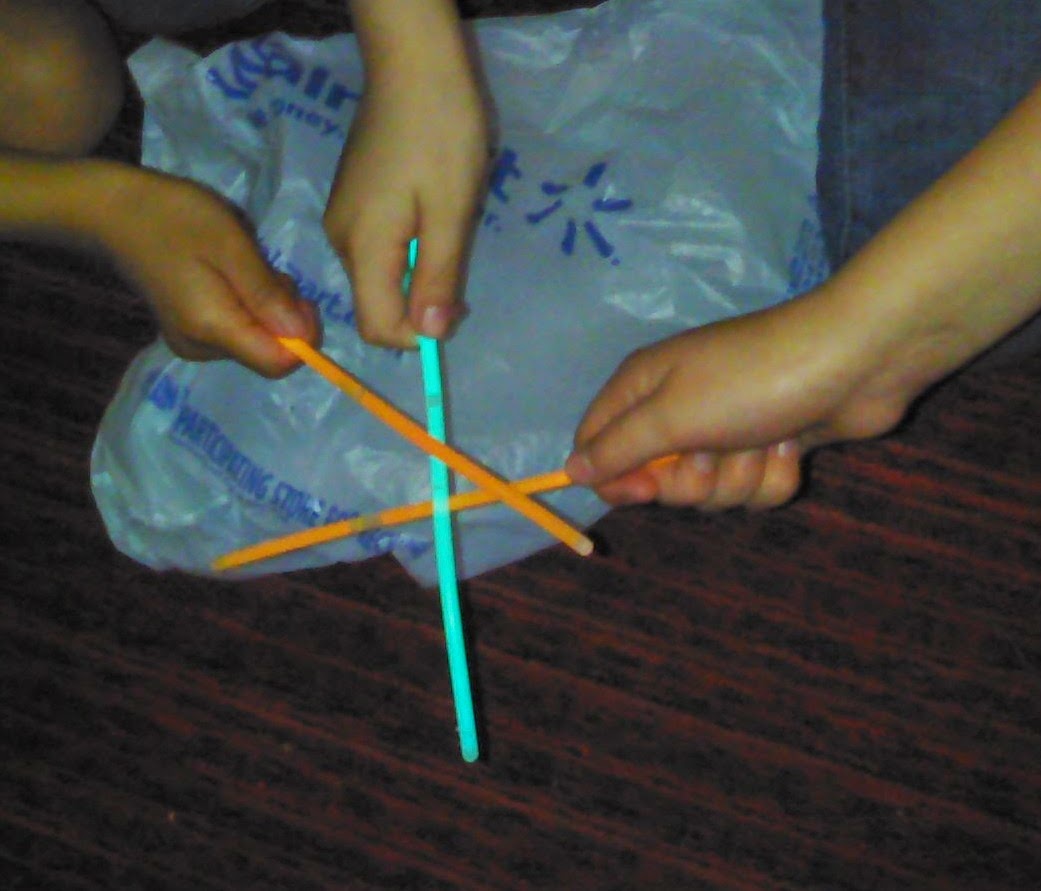
Heat Camera on Glow Sticks
I used an FLIR camera from a local museum to capture these images of hands holding glow sticks. The images show how the chemiluminescence of the sticks is considered to be a relatively cold source of light. The hands glow more brightly in the IR image than do the sticks!

Wednesday, July 9, 2014
Softening Point of 2-Liter PET Soda Bottles
When exothermic demonstrations are performed using 2 L polyethylene terephthalate (PET) soda bottles, the bottles sometimes soften and shrink. A great example of an exothermic reaction that can do this to PET bottles is the catalytic decomposition of 30% hydrogen peroxide. Wikipedia has mentioned that the glass transition of PET is about 70 C, so we set out to check to see if that corresponded to the softening point of the PET bottles. We heated a large kettle of water to various temperatures with a stove, checking the water temperature with a Vernier temperature probe. At selected temperatures, we placed a 2 L PET bottle nearly completely into the water (with its opening above water and the interior NOT flooded with water) for one minute. The results are shown in the picture below. At 65 C the bottle is unchanged, but at roughly 70 C and above, the bottle deforms. The extent of the bottle deformation seems to increase as the temperature increases. Thanks to Kristine Campbell for assistance with the experiment.

Sunday, June 29, 2014
Slow Motion Mentos and Soda
Have not posted in while in part because I have been busy developing demos. The addition of Mentos to soda is well known so I will not go into it in too much detail. Basically, the physical and chemical makeup of the shell of the Mentos helps the carbonation to quickly leave the soda, causing a fountain to rise up out of the bottle. I have attached a slow-motion video taken by Karen Dismang (using an iPhone5s) of Ben Hendrix doing this demo.
I have a couple comments:
1) Powdered Metamucil and other substances can cause soda to fizz - although Mentos work really well. Half of a roll of Mentos (seven candies) is enough to do the job. Not long before Mentos and soda was a "thing", it seemed that there were videos of ice cream and soda going around where someone would eat a bit of ice cream and then try to drink soda - perhaps similar chemistry?
2) Any soda or carbonated water should work. The color of the fountain will depend on the color of the soda. Tonic water fountains can be made to fluoresce with UV light (although one must be careful not to get the soda into the electrical fixtures). For indoor demos, I recommend using colorless soda, as I accidentally permanently stained a classroom ceiling tile with dark-colored soda. (Thankfully, the teacher thought it was funny.)
3) Use a diet soda. Sugary sodas can be sticky to clean up.
I have a couple comments:
1) Powdered Metamucil and other substances can cause soda to fizz - although Mentos work really well. Half of a roll of Mentos (seven candies) is enough to do the job. Not long before Mentos and soda was a "thing", it seemed that there were videos of ice cream and soda going around where someone would eat a bit of ice cream and then try to drink soda - perhaps similar chemistry?
2) Any soda or carbonated water should work. The color of the fountain will depend on the color of the soda. Tonic water fountains can be made to fluoresce with UV light (although one must be careful not to get the soda into the electrical fixtures). For indoor demos, I recommend using colorless soda, as I accidentally permanently stained a classroom ceiling tile with dark-colored soda. (Thankfully, the teacher thought it was funny.)
3) Use a diet soda. Sugary sodas can be sticky to clean up.
Wednesday, May 21, 2014
Liquid Nitrogen Marshmallows
This evening I brought home a little liquid nitrogen and we added marshmallows that were cut into quarters. The marshmallows soak up a little liquid nitrogen and become crunchy, almost like the marshmallows you find in cereal. When you bite into the marshmallows, their coldness causes the moisture in your breath to condense and produce the appearance of steam as you chew them. No need to use a full-sized marshmallow or just liquid nitrogen itself. Too much cold shock to the mouth could crack a tooth.


Subscribe to:
Posts (Atom)