Friday, August 15, 2014

Real vs. fake thermal images

Yesterday, someone showed me the "thermal" setting on digital camera software on their laptop computer.  Although this setting somewhat emulates the colors of many infrared images, these are not truly infrared images.  I think all this setting does is take visible light intensity, like one would see in a grayscale image, and convert it to the colors commonly seen in infrared images.  Here are three pictures of me: in conventional color camera mode, in "thermal" mode on a laptop camera, and in an infrared image on an FLIR camera.  Two things to note in the FLIR camera picture is that my glasses appear dark because they are cooler than the skin of my face and the writing on my shirt is not visible because it is the same temperature as the rest of my shirt. Thanks to the Peoria Riverfront Museum for the loan of the FLIR camera.


Monday, August 4, 2014

Grand Valley State University Bifilar Pendulum

Today I gave a presentation at the 2014 Biennial Conference on Chemistry Education (BCCE) at Grand Valley State University.  Beforehand, I found this pendulum nearby which traces patterns in the sand below it. Though it is an excellent demonstration of pendulum motion, it is also known for its five minutes of infamy, as GVSU students tried to ride the ball in satire of the Miley Cyrus wrecking ball video.  Apparently students have done this before, but some of them were unclothed and someone almost got injured, so the ball got taken down while the installation was redesigned.  News about this can be found here: http://www.businessinsider.com/grand-valley-state-university-reinstalled-the-miley-cyrus-wrecking-ball-sculpture-2013-11


Friday, August 1, 2014

Sound Spectrum of a Pop Toob

Pop Toob (or Rapper Snapper) toys make sounds that readily show the relationship between the lengths of the Toobs and the frequencies of the noises that they make when they change shape. I used SpectrumView to acquire a waterfall spectrum of a Toob as it is stretched to full length and then squeezed back to its minimum length.  Reading the waterfall spectrum from the bottom upward, note the frequency maxima shift to lower frequency as the Toob is stretched, and then the maxima shift back toward higher frequency as the Toob is re-compressed.

Wednesday, July 23, 2014

Infrared Image of Warm-Blooded and Cold-Blooded Animals

This FLIR image was taken of warm-blooded people and a pygmy African hedgehog, as well as a cold-blooded corn snake.

Tuesday, July 15, 2014

Vernier Oxygen and Carbon Dioxide Sensors Around a Campfire

I slowly walked around the glowing coals of a campfire tonight while holding Vernier oxygen and carbon dioxide sensors at about hip level.  The highs in the carbon dioxide readings correspond to lows in the oxygen readings, and these highs and lows correspond to when I was roughly east of the fire.  Though the wind was almost calm, it appears to me that the "smoke" from the fire was blowing toward the east.   I think under much more controlled circumstances this could lead to classroom/laboratory exercises in mapping plumes of gases from point sources.


Saturday, July 12, 2014

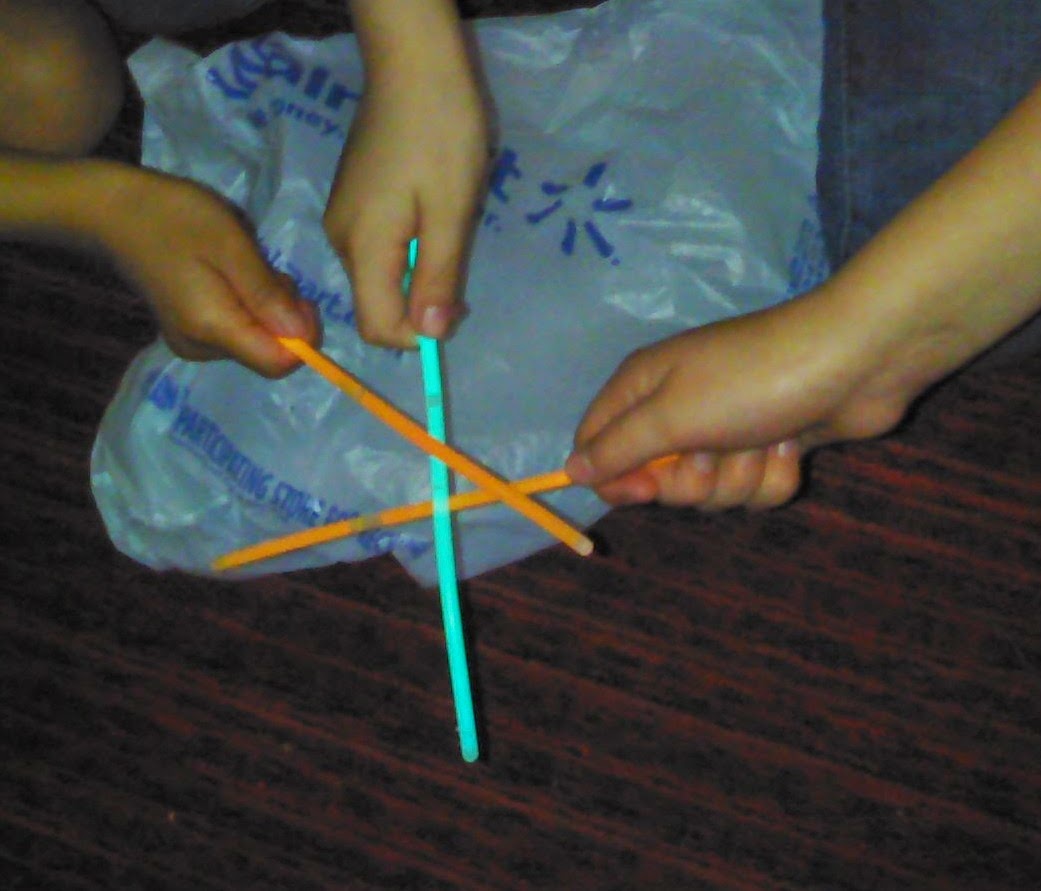
Heat Camera on Glow Sticks

I used an FLIR camera from a local museum to capture these images of hands holding glow sticks.  The images show how the chemiluminescence of the sticks is considered to be a relatively cold source of light. The hands glow more brightly in the IR image than do the sticks!


Wednesday, July 9, 2014

Softening Point of 2-Liter PET Soda Bottles

When exothermic demonstrations are performed using 2 L polyethylene terephthalate (PET) soda bottles, the bottles sometimes soften and shrink.  A great example of an exothermic reaction that can do this to PET bottles is the catalytic decomposition of 30% hydrogen peroxide.  Wikipedia has mentioned that the glass transition of PET is about 70 C, so we set out to check to see if that corresponded to the softening point of the PET bottles.  We heated a large kettle of water to various temperatures with a stove, checking the water temperature with a Vernier temperature probe.  At selected temperatures, we placed a 2 L PET bottle nearly completely into the water (with its opening above water and the interior NOT flooded with water) for one minute.  The results are shown in the picture below.  At 65 C the bottle is unchanged, but at roughly 70 C and above, the bottle deforms.  The extent of the bottle deformation seems to increase as the temperature increases. Thanks to Kristine Campbell for assistance with the experiment.